Potpourri
An Enduring Craft
In Pollachi, Tamil Nadu, a 74-year-old palm-leaf artisan, among the last of his kind, reveals a slow, sustainable craft, almost invisible today.
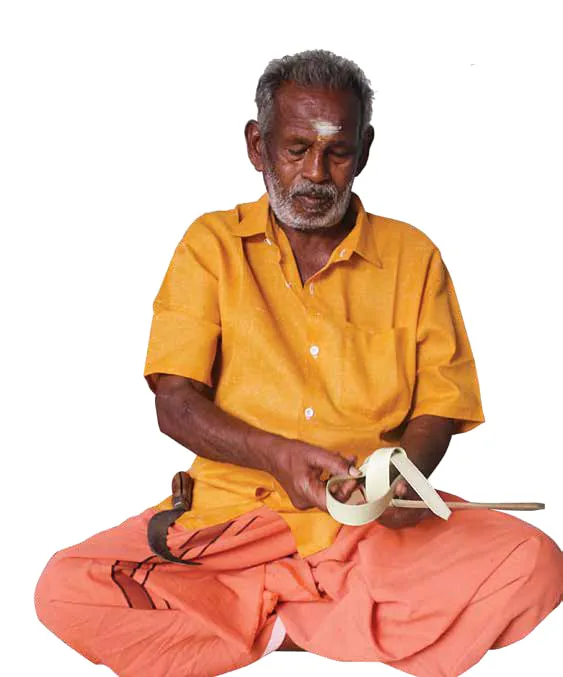
The first thing I noticed when I entered Krishnaswamy’s house in Kulathur, Pollachi, about an hour from Coimbatore, was how quiet the work was. No machines. No rush. Just hands moving. “This is the last family doing this here,” said my guide Muthu. Inside, strips of palm leaves lay in small, careful bundles. Some pale, some dyed in bright pinks, greens, and yellows. And in the middle of it all sat Krishnaswamy, 74, using a razor blade to carve a strip of palm leaf into the shape of a bird. “He makes everything—parrots, fish, flowers, baskets,” Muthu shared.
Krishnaswamy glanced up after finishing the fold. I asked him about the leaf. “It’s a tender palm leaf,” he replied. It has to be plucked at the right stage, when it is young and flexible. Then it’s left in the shade for 10 to 15 days. “After that, I soak the leaves in water for 15 minutes, so that they bend properly,” revealed Krishnaswamy. In a region where palm trees are part of the landscape—lined along fields, marking boundaries, standing through heat and drought—this craft is not separate from the land. It is an extension of it.
His wife, Karupathal, 61, sat nearby, sorting coloured strips. “For colour, we use hot water and chemical dye,” she mentioned. “Dip it, take it out, dry for two days. After that, we make crafts.” I picked up a small fish. Almost weightless, but complete in form. It would sell, I was told, for Rs 20 or Rs 25. I looked around the room again. The labour, the time, the precision — priced less than a cup of tea. Krishnaswamy makes over a hundred pieces a day. Still, the numbers don’t add up. “Where do they go?” I asked. “Villages, temples, weddings,” Karupathal answered. “Earlier, only zamindars and temples bought them, but now people buy them everywhere.”
Krishnaswamy’s father and grandfather made these crafts for the Agathooramman and Kali Amman temples, and for the zamindars of Uthukuli. Krishnaswamy, however, took it further by supplying different variations of the crafts on a larger scale. On the wall hung awards and certificates from 2017, 2018 and 2023. “His work has travelled farther than he ever has,” said Muthu jokingly. Recognitions have come from craft councils and local bodies. “We sent more than 3,000 pieces for Akash Ambani’s wedding,” Karupathal quickly added. But this shift carries a quiet loss. Demand is irregular, value negotiable, and skill expendable. And the craft now exists at the margins. “This is the last generation,” Muthu tells me. “They don’t have children.”
THE ADAPTABLE LEAF
Palm-leaf work appears in Kerala’s temple festivals and eco-weddings as woven arches, often made collectively in Chingoli-style displays. In Chettinad, similar techniques take shape as kottan (basket) elements. Across weddings today, they shift easily into boho, tropical, and rustic aesthetics. Even outside India, they show up in ceremonial arches, backdrops, table runners, baskets, and wedding chuppahs (canopies). In Bali, palm hangings called Lamak are still used in temples and rituals.
The parrots I had seen earlier, in long strands in Pollachi Riverhouse, also belong to this continuum. Large installations of these birds are now made in the hundreds, sometimes thousands, suspended from cascading lines or dense canopies during Ugadi, Makar Sankranti, and Diwali, or in mall exhibitions, associated as they are with fertility, prosperity, and temple iconography. “Every season, nearly 30 to 40 students come from Coimbatore and Pollachi to learn from me,” Krishnaswamy declares proudly. “I also teach at Kumarakulam and Gurukulam institutions.”
Still, learning a craft like this is not just about watching. It is about staying, repeating, failing, and returning. That kind of time and patience is disappearing. And yet, what is being lost is not only a skill. It is a way of creating that is inherently sustainable. The byproducts of palm-leaf craft are biodegradable, and leave almost no waste. The process consumes minimal energy. Even the drying depends on natural elements, compared to the synthetic alternatives that flood markets today.
But sustainability, in practice, does not guarantee survival. When a piece that takes hours to handcraft is sold for twenty rupees, sustainability becomes invisible labour. I watched Krishnaswamy start another piece. A strip folded, tightened, turned. A form emerging from nothing. There was no sketch, no measurement. Just muscle memory. This is what vanishes first — the memory in the hands. Not because the craft is not beautiful or useful, but because it cannot compete with a system that has no patience for slowness. Traditions survive as aesthetics, not as a necessity. I left Pollachi with a small parrot and a fish in my hand. It weighed almost nothing. But it carried time, history, skill, and the silence of a craft nearing its end