Face to Face
Her Voice Lives On...
In April, the world of music lost one of its brightest stars when Asha Bhosle passed away at the age of 92. Asha’s was a voice for all seasons and for every mood, as many a fond tribute recalled.
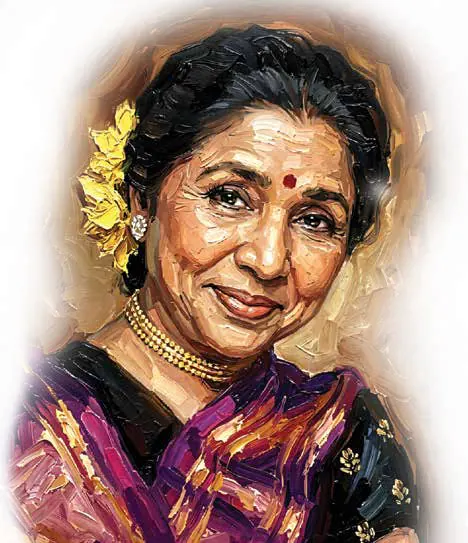
Born to Deenanath Mangeshkar and his second wife Shevanti, Asha was the third youngest of the famous Mangeshkar sisters. After their father’s untimely death at age 41, Asha and her eldest sister Lata began singing and acting to support the family. Asha was barely 10 when she stood in front of the microphone for her first film song, Chala Chala Nav Bala, for the Marathi film Mazhe Bal (1943).
But her breakthrough year in Hindi films was 1948, when she sang three numbers each in Andhon Ki Duniya and Chunariya. And in the following year, Asha recorded her first solo film song, for Raat Ki Rani.
However, unlike Lata—who achieved fame in Bollywood early on through her out-of-the-world singing in Mahal (1949) and Barsaat (1949)—Asha struggled for years to find her niche. Initially, her lone chance to sing came mostly in low-budget films, many of which were soon lost to obscurity, save for Bimal Roy’s Parineeta (1953) and Raj Kapoor’s Boot Polish (1954). In fact, it was only after the release of the latter films that she began to get noticed, and grow in popularity, nationally.
OP & RD: Hitting The Right Notes
Credit should go to O.P. Nayyar for discovering and nurturing her amazing talent and unique voice, for giving Asha her identity, and helping her step out of Lata’s shadow.
The extraordinary collaboration between the music director and the singer lasted for close to two decades, during which time they came up with multiple hits, across films like Naya Daur (1957), Howrah Bridge (1958), Kashmir Ki Kali (1964), Mere Sanam (1965), and Sawan Ki Ghata (1966), among a plethora of others. To me, their partnership reached its zenith with Asha’s ethereal Chain Se Humko Kabhi, from Pran Jaye Par Vachan Na Jaye (1974), though the song was ultimately left out of the film.
Another gifted music director who played a crucial role in bringing out Asha’s versatility and phenomenal range was none other than the maverick and experimental R.D. Burman, the vocalist’s second husband. This partnership brought forth perennial hits such as Chura Liya Hain Tumne Jo Dil Ko, Dum Maro Dum, Oh Mere Sona Re, Daiya Yeh Main Kahan Phasi, Piya Tu Ab Toh Aaja, and Mera Kuchh Samaan. The RD-Asha magic, too, endured for a couple of decades, dominating Bollywood from the late 1960s to the end of 1980s. Indeed, theirs was an alliance that revolutionised Hindi film music.
Her repertoire stretched well beyond the Bollywood songs to incorporate ghazals, bhajans, classicals, qawwalis & Rabindra Sangeet
During a career that spanned a remarkable eight decades, Asha also sang for other prominent music directors, including S.D. Burman, Jaidev, Khayyam, Ravi, Bappi Lahiri, A.R. Rahman, and Ilaiyaraaja. And her repertoire stretched well beyond the Bollywood universe to incorporate ghazals, bhajans, Hindustani classical, qawwalis, and Rabindra Sangeet (songs composed and written by Rabindranath Tagore).
A Lasting Legacy
According to the renowned Rabindra Sangeet singer Swagatalakshmi Dasgupta, Asha’s voice modulation and adaptability made her a truly great artiste. “Ashaji’s god-gifted voice effortlessly waltzed from a cabaret number to a romantic duet to a ghazal to Rabindra Sangeet with fascinating dexterity, without losing the nuances demanded from each such rendition. Her musical potency never ceases to amaze me.”
And, believes Kolkata-based music composer, Debajyoti Ghosh, “To R.D. Burman and Ashaji should go the credit for giving a massive momentum to the application of western musical styles and form in Bollywood. And I am quite sure Ashaji was the first to make cabaret singing mainstream in Hindi cinema. Her legacy will continue to inspire many future music-makers and singers in India.”
Over eras and generations, Asha’s mesmerising voice effortlessly transcended man-made borders to leave an indelible impact as much on listeners abroad as it did on those in India. She overcame adversity and personal tragedies to dedicate her life to singing, still delighting millions across the world well into her 70s, 80s, and even 90s. Asha’s legacy will surely endure, and her voice will linger on in our hearts
Top 10 Asha Solos
- Aaiye Meherban for Howrah Bridge (1958)
- Jahan Main Aisa Kaun Hai for Hum Dono (1961)
- Jaiyee Aap Kahan Jayenge for Mere Sanam (1965)
- Raat Akeli Hai for Jewel Thief (1967)
- Daiya Yeh Main Kahan Phasi for Caravan (1971)
- Dum Maro Dum for Hare Rama Hare Krishna (1971)
- Chain Se Humko Kabhi for Pran Jaye Par Vachan Na Jaye (1974)
- In Aankhon Ki Masti for Umrao Jaan (1981)
- Katra Katra for Ijaazat (1987)
- Mera Kuchh Samaan for Ijaazat (1987)