GetawayVaranasi
The Eternal Charm
Varanasi, or Banaras, is best experienced slowly—at sunrise on the river, during the evening aarti, through its bustling bazaars, and over street food savoured standing in its lanes.
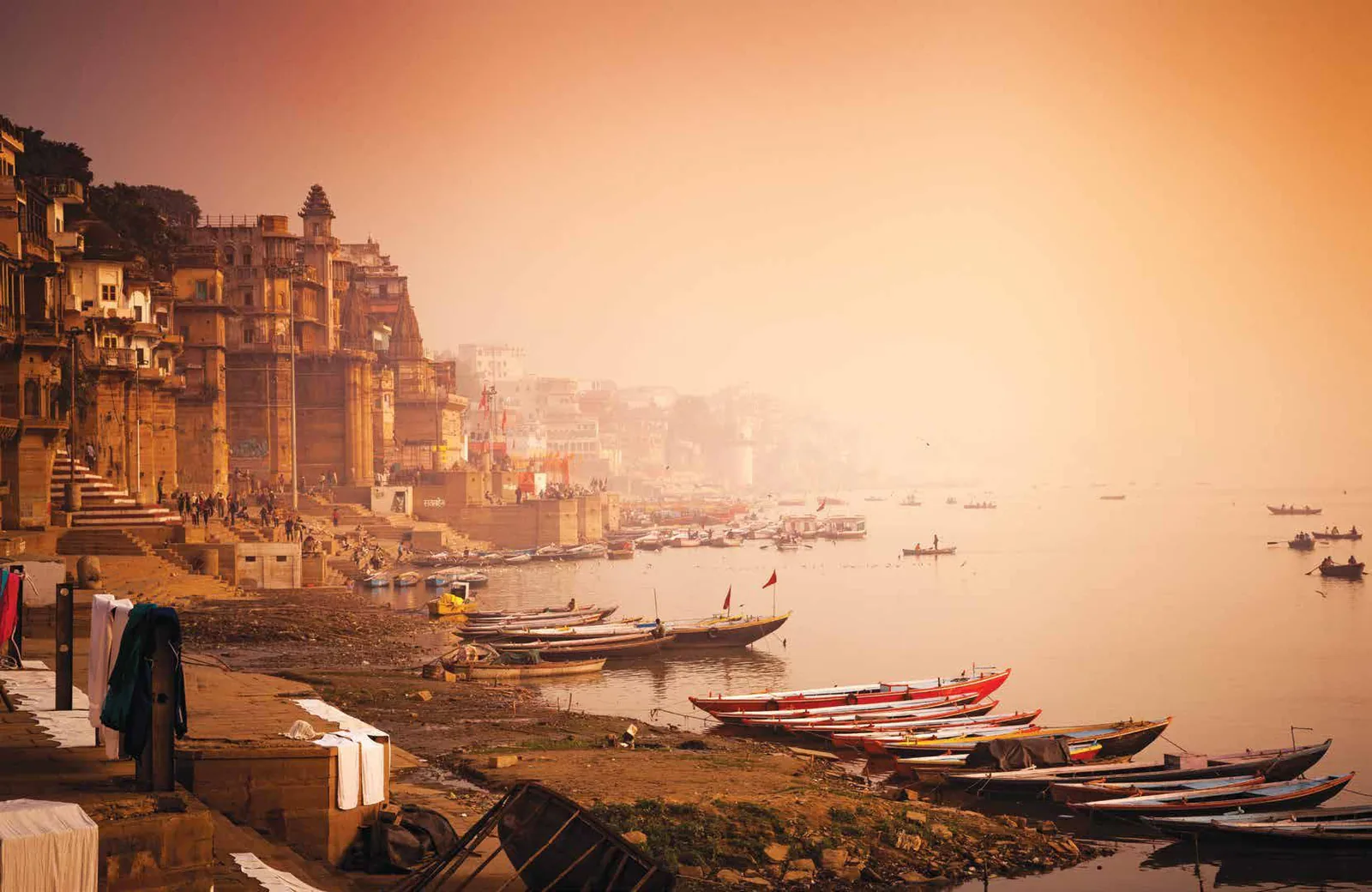
Varanasi is unique in many ways. Not only because it is considered to be the world’s oldest living city, dating back more than 3,000 years, but because it leaves an indelible impact on whoever visits. It overwhelms you, surprises you, jolts your senses, and somehow, its omnipresent chaos leaves you calmer than before. It is also not an easy city that one falls in love with instantly.
In Varanasi, devotion and daily life have always gone hand in hand. Temples appear at every turn and life unfolds along the ghats with a kind of intensity that feels both chaotic and deeply moving (it is fairly common to see loved ones carrying the deceased towards the funeral pyre). But beyond its Hindu identity, the city has long been a meeting point for Buddhists, Jains and Muslims too, and integral trading stop with many of its master craftsmen continuing traditions that have defined Varanasi for centuries. Somewhere within all the noise, narrow lanes and traffic snarls is a strange sense of peace—one that only this city seems to understand.
OF TEMPLES GHATS AND EVENING AARTI
In Varanasi, the Ganga is not merely a river but a living deity, shaping the spiritual rhythm of the city. As evening falls, the ghats come alive with the mesmerising Ganga aarti, where priests move in perfect synchrony, lamps blaze through curls of incense, and chants ripple across the water. At Dashashwamedh Ghat, the evening aarti dazzles with fire and chants, while Assi Ghat offers quieter dawn rituals during Subah Banaras. Along the Ganges, Varanasi’s 84 ghats each have their own character, ranging from the cremation fires of Manikarnika and Harishchandra Ghats to the newly developed Namo Ghat at the city’s northern edge.
Beyond the riverfront, devotion spills out of countless temples. Step into the newly expanded Kashi Vishwanath Corridor or wander through the serene expanse of Sarnath, and Varanasi unveils its calm soul. While the revered Shri Kashi Vishwanath Temple is home to one of 12 sacred Jyotirlingas, there are also the esteemed Kaal Bhairav Mandir and Sankat Mochan Hanuman Temple, each drawing millions of pilgrims seeking blessings, protection and solace. If you don’t get sucked into the rituals, it’s easy to spend hours at each of these, soaking in the vibrant energy—with more than 100,000 temples, there are temples of all sizes and for innumerable deities.
BEAUTY IN SILK AND HANDCRAFTED LEGACY
Shopping here feels less like retail and more like stepping into a living workshop. In Gol Ghar, Varanasi’s bustling wholesale hub, traders, weavers and artisans move through stacks of brocades and shimmering silks fresh off the loom. Jewel tones, intricate motifs and classic gold zari come without the inflated prices of metropolitan boutiques, making these heirloom textiles surprisingly accessible. Beyond silk, the city’s creative identity deepens in its narrow lanes, where the endangered art of gulabi meenakari—delicate pink enamel unique to Banaras—is being revived. Once nearly lost, it has returned through government support and artisan initiatives, with around 50 families practising it again and younger generations being trained. Nearby, Bhadohi is the largest carpet weaving cluster in the country, producing hand-knotted and hand-tufted carpets for global markets. These are just a few examples of how Varanasi’s craftsmanship is a living tradition passed carefully from hand to hand across generations.
VARANASI ON A PLATE
The city feeds the soul and the stomach with equal generosity, and nowhere is this more evident than in its bustling gullies, where every few steps bring a new aroma and a new specialty.
The day often begins with chai, Lakshmi Chai Wala pairs it with the city’s beloved “scissor toast”, thick slices of bread snipped in the middle and stuffed with unapologetic amounts of butter. Breakfast in Banaras is serious business, and few places capture that better than the kachori-sabzi at Ram Bhandar. The flaky kachoris, paired with a fiery potato curry, are legendary, and for good reason.
Then comes the chaat, any day, every day. At places like Kashi Chaat Bhandaar and Deena Nath Chaat Bhandaar, the choices include the special tamatar ki chaat simmered with spices and topped with crisp sev, buttery matar ki chaat, and even poha prepared in a distinctly Banarsi style. Evening time, one look at Vishwanath Sahu’s golden-crisp samosas and you know why the simplest snack is an institution in this city. For something lighter, there is the dreamy malaiyyo at Pahalwan Lassi, light and airy delicacy made from milk froth and dew, and of course, the lassi itself is special as it is thick enough to be eaten with a spoon! And finally, the Banarasi paan owes its special flavour to the betel leaf itself, prized for its natural sweetness and delicate texture that ensures that you don’t need to chew it—it literally melts in the mouth over time.
MORNING RAGAS AND EVENING DANCE RECITALS
In Varanasi, classical music and dance are woven into the city’s everyday rhythm. Kabir Chaura remains the heart of this legacy, home to the celebrated Banaras tabla gharana founded by Pandit Ram Sahai. The city’s soulful thumri tradition still lingers in intimate performances, while Kathak thrives through expressive storytelling and intricate footwork passed down across generations. The haunting sound of the shehnai recalls Banaras’s deep spiritual ties to music, shaped by legendary maestros and enduring guru-shishya traditions that continue to define the cultural soul of the city