GetawayAmritsar
Of Faith and Flavours
Outside of the hallowed Sri Harmandir Sahib (Golden Temple), Amritsar has a fascinating past that can be discovered within its narrow, 400-year-old bylanes and alleyways
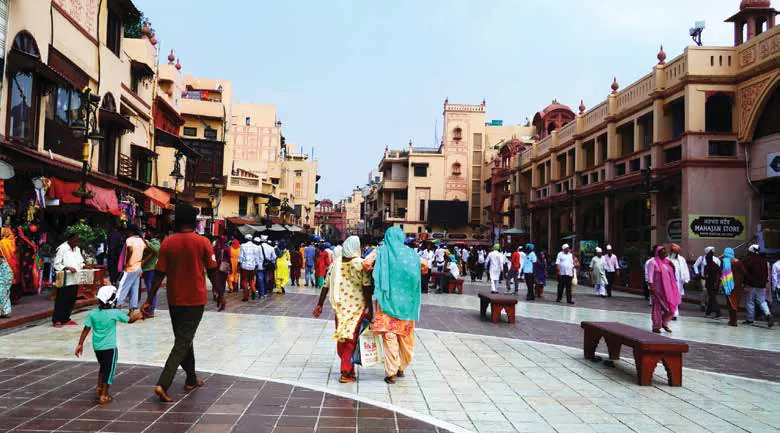
Amritsar is history, traditions, culture and crafts – all wrapped into one, and perhaps the best way to experience it would be by walking along its streets and lanes. Morning is the ideal time for a heritage walk, for that is when the city is still waking up - and that is how I explored Amritsar. You pass through Katras (fortified residential units), Akharas (wrestling arenas), Bungas (rest houses), Havelis, and Hattis or shops, each showcasing how Amritsar founded around 1574, was developed.
DATE WITH HISTORY
The starting point is the historic rust-hued Town Hall, built in 1870. This towering edifice was used by the British as an entertainment space, with live bands playing every evening. Its top floor has a bell that would be rung whenever the British had to communicate a message to the people. Today, Town Hall’s premises share space with the famed Partition Museum — and as you make your way through the museum, look up and take in the beautiful sight of Murano glass chandeliers hanging from the ceiling. Close by is the Jama Masjid Jaan Mohammed, dating back to 1867, and the Saragarhi Memorial Gurudwara, dedicated to the 21 soldiers of the 36th Sikh Regiment who were martyred by Afghan tribesmen in the Battle of Saragarhi, in 1897. While you mull over Amritsar’s history, gather your thoughts over a hot cup of tea at the Jalebi Wala Chowk, a square that hosts several small eateries (no prizes for guessing that it is well-known for its jalebis!). Look out for Qila Ahluwalia, almost hidden under a maze of shops and hanging wires. Its façade boasts colonial-style architecture and elaborate stonework, while inside lie an ancient well and stable. Stop a while at the Udasin Ashram Akhara Sangalwala (1771), and the Chitta Akhara, established in 1781. The latter has an ancient tomb within, surrounded by vibrant paintings and religious idols. Today, the alleys around here are bustling markets selling jewellery and clothes.
IF BRICKS COULD SPEAK…
Make it a point to observe the Nanakshahi bricks, unique to Sikh architecture. Thin, red in colour, hand-moulded, and clay-fired, these bricks have low porosity and are used in the construction of many of the buildings here. Another important element is the Pinjara woodwork and wood-carving technique, which can be spotted in a fair number of the city’s older structures. Spend time at Darshani Deori, the place where Guru Arjan and Guru Hargobind would stand and gaze upon the Golden Temple, when the views were unobstructed — don’t forget to admire the archway’s stunning ceiling, all painted and gilded. And as you make your way towards the end of Bartan Bazaar, you will catch glimpse of a revered banyan tree, which has witnessed the creation of Amritsar. Then there’s the Thakurdwara Dariana Mal, whose colonial-era design is accentuated with frescoes of intricate floral patterns and detailed ornamentation. Also check out Chaurasti Attari, whose four passages house 32 shops; it was built in the early 1600s by the sixth Guru, Guru Hargobind, who had invited the traders here and often spent time with them. Meanwhile, located at Katra Hari Singh is the city’s first mint, or Taksal, where thousands of coins have been minted over the years. And as you end the walk through an ancient passage, it is impossible not to appreciate how beautifully the city straddles the past and the present — as good a reason for you to add Amritsar to your travel wish-list this year.
FOOD FOR THE SOUL
The food scene in Amritsar is an ode to, and a reflection of, Punjab’s culinary exuberance. While in town, you can’t miss Amritsari kulcha and chole, Amritsari Machhi—a fried fish especially popular at the Makhan Fish restaurant—and the sweet and creamy lassi. And if you’re visiting in winter, tuck into the classic comfort food that is Sarson da Saag and Makki di Roti. For more humbler fare, partake of the Guru ka Langar at the Golden Temple, and marvel at how the community kitchen works. Kesar da Dhaba and Gian di Lassi are renowned for their local fare, and vegetarians must halt at Haveli, which serves delectable food at very reasonable prices.
BAZAARS OF WONDER
Amritsar is also a shopper’s delight. Stop by the bustling and bursting-with-variety Hall Bazaar near the Golden Temple, Katra Jaimal Singh Market for vintage Punjabi clothes and footwear, and Guru Bazaar for traditional jewellery. Keep your eyes peeled for the hand-embroidered and colourful Phulkari, textiles, shawls, and Punjabi juttis, and (among other food items) papads and warian—especially in the shops around Sri Harmandir Sahib. And pick up some delicious local pickles, a great way by which to remember your visit to this many-splendored city
NOW APPLY FOR VISA ON WWW.SPICEJET.COM.
VISA ON YOUR MIND?
WE WOULD LOVE TO HEAR FROM YOU!
If you have any feedback or suggestions on any aspect of our services, please send us an e-mail at custrelations@spicejet.com You may also send your feedback to the following people:
NODAL OFFICER:
Mr Sachin Suri nodalofficer@spicejet.com
APPELLATE AUTHORITY:
Mr Kamal Hingorani appellateauthority@spicejet.com.
You may also visit www.dgca.nic.in or write to sugam@dgca.nic.in
THE MINISTRY OF CIVIL AVIATION
, Government of India, has upgraded its Air Sewa portal, which is accessible through both interactive web portal and mobile app. The new version includes the following features: a) Secure sign-up and log-in with social media b) Chatbot for travellers' support c) Improved grievance management, including social media grievance d) Real-time flight status and detailed flight schedule Air Sewa is available at www.airsewa.gov.in