Bon Appétit
Sweet Surprise, Japanese Style
Simple yet sophisticated, Japanese desserts are enjoying a moment in India, courtesy of their subtle flavours and varying textures.
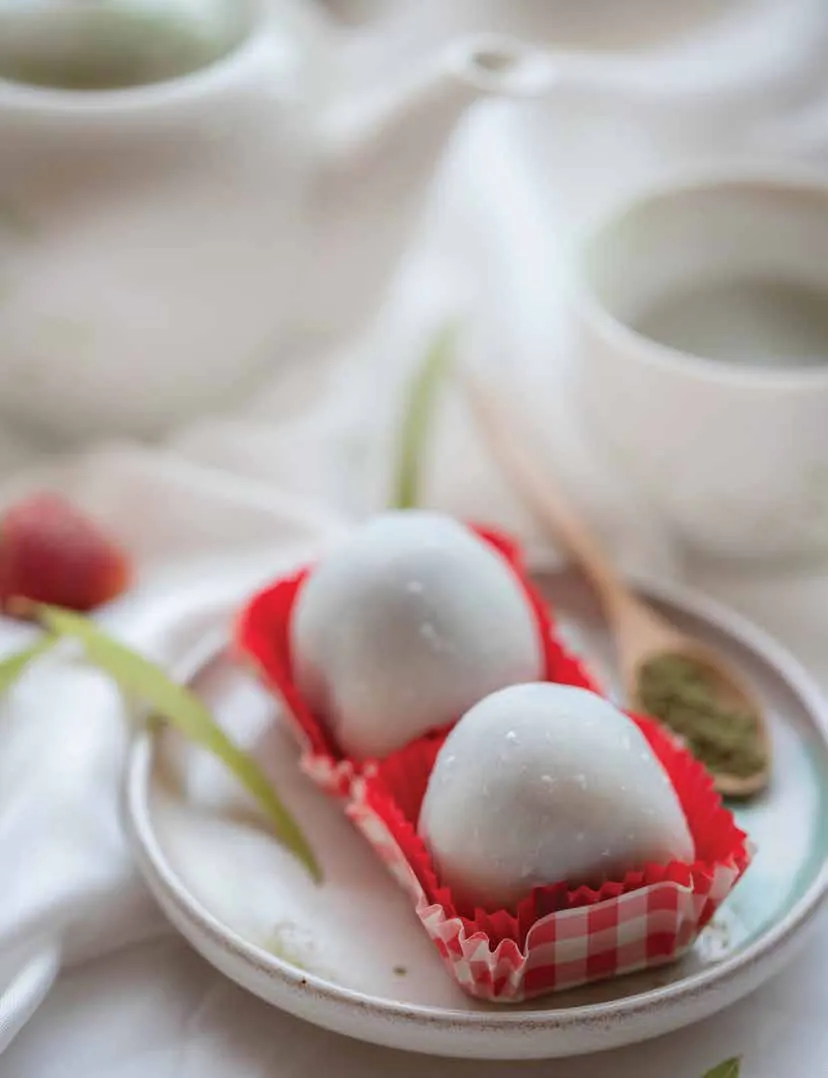
For a large part of Japan’s past, sweets were imagined as an expressive art form rather than simply a conduit for sugar. “In fact, for much of Japanese history, sugar was expensive and not widely accessible, so ingredients such as chestnuts and sweet potatoes were often used to create sweetness,” reveals Nooresha Kably, chef and co-founder of Mumbai hotspots Izumi and Idoru. Traditional Wagashi makers sought to capture a fleeting moment or the essence of a season through a sweet. Much like a haiku, a Japanese sweet can express so much through its appearance, aroma, texture, and flavour. Wagashi, the Japanese sweets she refers to, are more like confectionery than the puddings and pastries found in many other cuisines. They evolved alongside the Japanese tea ceremony as bite-sized sweets designed to balance the bitterness of tea. Japanese desserts encompass both these traditional confections and more modern creations that emerged through Western influence. “As a result, they tend to be simpler than the elaborate desserts one might find in other cultures. They are delicate and have a sense of purity about them,” explains Kably.
“Like the rest of Japanese culture, wagashi are deeply seasonal. You’ll find sakura and strawberry flavours in spring, watermelon-inspired sweets in summer, chestnut and sweet-potato desserts in autumn, and warm, syrupy, and flambéed or yakimochi desserts during winter,” she adds.
Of Taste & Texture
Mochi – a dessert that is light, not overwhelmingly sweet, and fun to eat – has been trending for a while now. Another is the Japanese-style cheesecake, which has become quite the favourite due to its texture, light and airy compared to the heavier and creamier standard cheesecake. “We have a lovely Japanese cheesecake which we top with mango compôte, since it’s mango season. The versatility of the dessert lends itself well to the changing season,” maintains Ashley D’Souza, Head of Operations, Bangalore & New Markets, Ammi F&B Services, Katana.
Besides the lightness of the cheesecake – not too heavy, just right, and the perfect end to a great meal – it’s the contrast in textures that makes this dessert such a big draw, according to Nikhil Menon, Cluster Head Chef & Head Pastry Chef at Mizu Izakaya, Mumbai. “Imagine biting into the gummy exterior of a mochi with cold and smooth strawberry ice cream, and tart, sweet strawberry jam. Or biting into a cheesecake which looks dense, but when you take a bite, it just melts like a cloud,” he tempts. “It takes you on a sensorial journey which is worth experiencing.”
These desserts use several quintessential ingredients, which gives them their unique taste and texture, among them mochigome (glutinous rice, used primarily in mochi) and the hugely popular matcha, which is derived from tea leaves. Says Anand Morwani, Chef Partner, Gaijin, Mumbai, “At Gaijin, we take inspiration from these ingredients while interpreting them through our own lens. For example, our chocolate fondant incorporates miso and is paired with a goma (sesame) ice cream, creating a balance between richness, sweetness, and umami. Similarly, our Brie cheesecake uses wasabi sesame crackers and pink peppercorn honey, borrowing from Japanese flavour profiles while introducing elements that feel contemporary and unexpected.”
Perhaps the most important shift, however, is the growing emphasis on ingredient-driven storytelling. Diners today want to know where their food comes from, and the people behind it.
Delicate & Delectable
Japanese desserts are undergoing a fascinating evolution, where tradition and innovation coexist beautifully. “While classic favourites such as mochi, dorayaki, and Japanese cheesecakes continue to be popular, there is a growing movement towards what many chefs call ‘third-culture desserts’, creations that blend Japanese techniques and ingredients with influences from around the world,” mentions Debolina Datta, Junior Sous Chef, Tomo Kei, Sheraton Grand Bengaluru Whitefield Hotel and Convention Centre.
Among the most exciting trends is the rise of hybrid desserts, which combine the familiarity of Western pastries with distinctly Japanese flavours and textures. “We are seeing ingredients such as matcha, yuzu, miso, hojicha, kinako, and black sesame being incorporated into everything from croissants and mille-feuille to cheesecakes and ice creams. There is also increasing experimentation with umami-forward desserts, where ingredients like miso add complexity and depth rather than simply sweetness,” Datta adds.
Perhaps the most important shift, however, is the growing emphasis on ingredient-driven storytelling. Diners today want to know where their food comes from, and the people behind it. Japanese dessert culture has always championed such a philosophy through its respect for seasonality and provenance, making it particularly relevant to contemporary dining. Indian chefs are adapting these trends through a local lens; rather than simply recreating Japanese desserts, they are pairing Japanese techniques with indigenous ingredients, regional produce, and local stories. The result is desserts that feel both globally inspired and deeply rooted in place
SPICE2050 APPLY THE CODE
CASHBACK
FOR FIRST-TIME USERS OF
PATHOLOGY TESTS
CONNECTING YOU WITH TRUSTED LABS ACROSS INDIA
COMPARE
Prices & Ratings Of 2500+ Labs
DECIDE
Based On Your Preference
SAVE MORE
For The Same Test At Your Preferred Lab To Book Visit www.flebo.in or Call 012 44 55 0000 500+ Bookings Everyday 3000+ Pathology & Radiology Tests 250,000+ Satisfied Customers
SEARCH
Any Lab, For Any Test, At Any Location
NOW AVAILABLE
INDIA WIDE
Get Package Recommendations 24X7 Doctor Consultations Access Reports In One Place #AllReportsAlwaysAvailable Monitor Test Results #HealthTrendGraphs Compare Labs & Save Money 4.9 33,000+