Day in a City
Jaipur: In History’s Glow
Jaipur wakes unhurriedly, wrapped in shades of rose and warm sandstone. From latticed windows that catch the earliest light to hilltop forts holding the last glow of the day, the city reveals itself best not by ticking off landmarks, but by moving gently between them, allowing each place to lead naturally to the next.
MORNING LIGHT AT HAWA MAHAL
As the sun rises, the delicate façade of Hawa Mahal, an intricate honeycomb of 953 jharokhas, softly absorbs the morning light. Designed so that royal women could observe the city unseen, the palace still feels quietly watchful. Below, vendors lift shutters, scooters ride past, and the Pink City stirs into motion. This is Jaipur before the crowds arrive, when the colour feels almost intimate. A cup of hot chai from a nearby stall completes the moment—simple, grounding, and unmistakably local.
Next stop: 5 minutes on foot
A WALK THROUGH THE OLD CITY
Step away from the main road and the city softens. Narrow lanes curl behind Hawa Mahal, unveiling small temples tucked into corners, artisans polishing gemstones by hand, and shopfronts painted in Jaipur’s iconic shade of pink. This is the city where every turn offers a subtle detail—bells chiming, mirrors catching light, the scent of fresh kachoris drifting through the air. Pause for breakfast at Laxmi Mishtan Bhandar, a local institution where traditional sweets and savouries have been served for generations.
Next stop: 7 minutes on foot
ROYAL PAUSE AT CITY PALACE
At the heart of the old city lies the City Palace, still part-home to Jaipur’s former royal family. Inside its walls, the tempo shifts. Courtyards open out one after another, each defined by symmetry, colour, and hushed grandeur. The Peacock Gate gleams with layered symbolism, while museum galleries display silks, ceremonial weapons, and manuscripts that speak of power, patronage, and precision. Here, Jaipur feels carefully composed, a city imagined, planned, and executed with remarkable intent.
Next stop: Right next door
TIME STOPS AT JANTAR MANTAR
At Jantar Mantar, the monumental astronomical instruments rise from the ground like sculptural forms, built not for ornamentation but for exactness. Long before satellites and digital clocks, these structures measured the movement of celestial bodies with astonishing accuracy. Walking among them is unexpectedly calming, a reminder that Jaipur has always balanced beauty with intellect, observation with imagination. Follow a visit to the observatory with lunch at Govindam Retreat, where a traditional Rajasthani thali is served with a quiet generosity and warmth.
The Peacock Gate gleams with layered symbolism, while museum galleries display silks, ceremonial weapons and manuscripts
Next stop: 10 minutes on foot
AFTERNOON HUES IN JOHARI BAZAAR
By noon, the city is fully awake. Johari Bazaar shimmers with gemstones, lac bangles, and finely crafted jewellery, while textile shops display block-printed fabrics in endless variations. Conversations flow easily here—between shopkeepers, artisans, and visitors—making the bazaar feel as much social as commercial. This is Jaipur at its expressive best: vibrant, layered, and unapologetically alive.
Next stop: 30 minutes drive
SUNSET AT NAHARGARH FORT
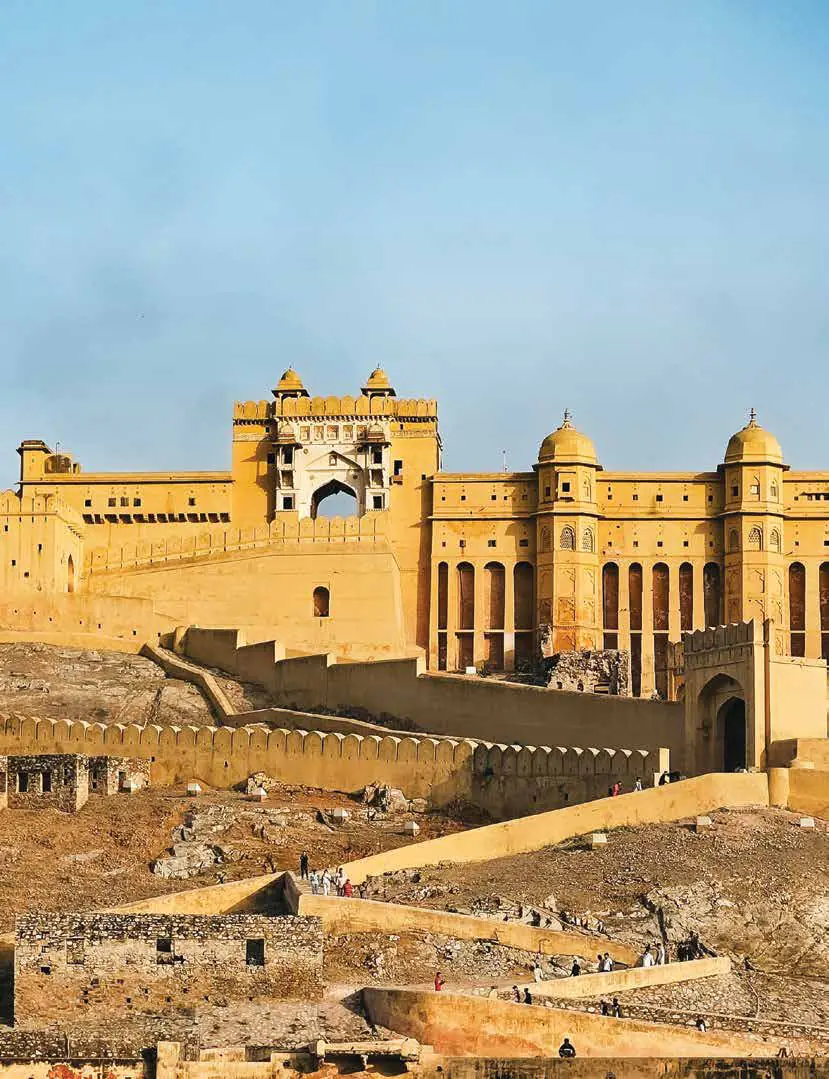
As the day begins to slow, a short uphill drive 30mins from Johari Bazaar, leads you to the majestic Nahargarh Fort. From this vantage point, Jaipur stretches out below in muted geometry, pink blocks fading into gold as the sun dips lower. Gradually, city lights flicker on, tracing familiar roads and neighbourhoods in a gentle glow. It is a moment made for reflection, not just on the day, but on the city itself.
AT PINK CITY’S EMBRACE
Return to the old city as night settles in. Rooftops glow enticingly, conversations linger, and the air cools just enough to tempt an unhurried dinner. Jaipur feels intimate again, measured and composed. It’s a city, you notice, that does not rush its visitors. It simply invites them to stay a little longer